Featured
Table of Contents
The business resource planning (ERP) software segment accounted for the biggest market share of over 29% in 2024. Enterprise Resource Preparation (ERP) software application is an integrated and extensive suite of applications that enhance and optimize critical business procedures within organizations. b. A few of the key gamers running in the market include Accenture, Broadcom Inc., Cisco Systems Inc., Deltek, Inc., Epicor Software Application Corporation, Hewlett Packard Enterprise, IBM Corporation, Infor, Microsoft Corporation, Oracle Corporation,, Inc., SAP SE, SYSPRO, TIBCO Software Application Inc., and VMware, Inc.
b. The increasing choice for automated and incorporated options is driving the development of the business software market. As more organizations seek streamlined, reputable software to decrease reliance on human resources, automate regular jobs, and minimize manual mistakes, the need for business software solutions continues to increase. This shift is targeted at improving overall functional performance across markets.
The Enterprise Software application market is a quickly growing market that is continuously developing to meet the needs of companies worldwide. With the increasing demand for digital transformation, the market has actually seen substantial development over the last few years. Customers are significantly trying to find software application solutions that are versatile, scalable, and easy to utilize.
Top Tips for Enterprise Success in 2026
Cloud-based solutions are becoming increasingly popular, as they provide greater flexibility and scalability than conventional on-premise solutions. Consumers are also searching for software solutions that can help them enhance their operations, minimize costs, and enhance their bottom line. In The United States and Canada, the Business Software application market is controlled by the United States, which is home to a number of the world's biggest software companies.
In Europe, the market is driven by the increasing demand for digital change, along with the requirement for software application options that can assist companies abide by the General Data Defense Regulation (GDPR). In Asia-Pacific, the marketplace is driven by the increasing adoption of cloud-based services, along with the growing variety of little and medium-sized business (SMEs) in the area.
The marketplace is driven by the increasing need for cloud-based options, along with the growing number of SMEs in the country. In India, the marketplace is driven by the increasing adoption of mobile gadgets, in addition to the growing variety of start-ups in the nation. The marketplace in Latin America is driven by the increasing need for software services that can assist organizations abide by regional guidelines, along with the requirement for options that can assist services handle their operations more efficiently.
In lots of countries, the marketplace is driven by the increasing need for digital improvement, as services aim to improve their operations and stay competitive in a progressively digital world. The marketplace is also driven by the increasing adoption of cloud-based services, as services look to decrease expenses and enhance their flexibility.
The databook is created to work as a thorough guide to browsing this sector. The databook focuses on market stats denoted in the form of profits and y-o-y growth and CAGR across the globe and areas. An in-depth competitive and opportunity analyses associated with business software application market will help companies and investors design strategic landscapes.
Is the Enterprise Ready for 2026 Growth?
Horizon Databook has segmented the North America business software market based upon business resource planning (erp) software, service intelligence software, content management software application, supply chain management software, consumer relationship management software application, other software covering the earnings development of each sub-segment from 2018 to 2030. The appealing rate of technological improvements in the area, combined with the heightened adoption of cloud-based enterprise options among organizations, is anticipated to drive the demand for enterprise software application.
This circumstance is anticipated to drive the development of the North America enterprise software market. Access to detailed data: Horizon Databook supplies over 1 million market data and 20,000+ reports, using extensive protection across numerous industries and areas. Educated decision making: Customers gain insights into market patterns, customer choices, and rival strategies, empowering notified service decisions.
Personalized reports: Tailored reports and analytics permit companies to drill down into particular markets, demographics, or item segments, adapting to unique organization needs. Strategic advantage: By staying upgraded with the current market intelligence, business can remain ahead of competitors, expect industry shifts, and take advantage of emerging chances. Our clients consists of a mix of enterprise software market business, investment firms, advisory firms & scholastic organizations.
Modern Sales Enablement Tactics to Close More Deals
Approximately 65% of our profits is produced working with competitive intelligence & market intelligence groups of market individuals (producers, company, etc). The rest of the profits is created dealing with scholastic and research not-for-profit institutes. We do our little bit of pro-bono by dealing with these institutions at subsidized rates.
This continent databook includes high-level insights into The United States and Canada enterprise software market from 2018 to 2030, including earnings numbers, significant trends, and company profiles.
Market OverviewStudy Period2020 - 2031Market Size (2026 )USD 0.74 TrillionMarket Size (2031 )USD 1.28 TrillionGrowth Rate (2026 - 2031)11.58% CAGRFastest Growing MarketAfricaLargest MarketNorth AmericaMarket ConcentrationLow * Disclaimer: Major Players sorted in no specific orderImage Mordor Intelligence. Reuse needs attribution under CC BY 4.0. Image Mordor Intelligence. Reuse requires attribution under CC BY 4.0. Select Another GeographyEurope [] Business Software Market size was valued at USD 0.66 trillion in 2025 and is approximated to grow from USD 0.74 trillion in 2026 to reach USD 1.28 trillion by 2031, at a CAGR of 11.58% throughout the projection period (2026-2031).
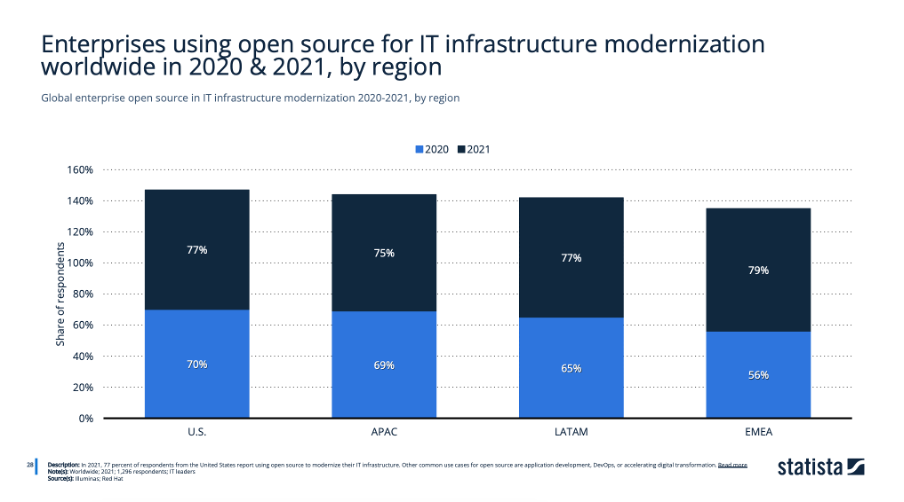
Vendors are racing to bundle generative copilots into everyday workflows, which is tightening lock-in for incumbents while opening white-space opportunities for vertical specialists. Low-code platforms are spreading person development beyond IT, while unified data fabrics are solving integration bottlenecks that formerly slowed analytics programs. At the exact same time, cost pressure from open-source options and cloud-cost optimization programs is forcing vendors to justify every function through quantifiable efficiency or compliance gains.
Chauffeurs Effect AnalysisDriver() % Impact on CAGR ForecastGeographic RelevanceImpact TimelineAI-Powered Workflow Automation Adoption +2.8%International, weighted to The United States and Canada and EuropeMedium term (2-4 years)Shift to Membership SaaS Income Models +2.5%GlobalLong term (4 years)Demand for Unified Data Fabrics +1.9%The United States And Canada, Europe, core APAC marketsMedium term (2-4 years)Low-Code No-Code Platforms in Resident Advancement +1.7%Global with velocity in SME-dense regionsShort term (2 years)Emerging Vertical-Specific Copilots +1.4%The United States And Canada, Europe, APAC healthcare and BFSI hubsMedium term (2-4 years)Algorithmic ESG Cost Optimizers +1.2%Europe and North America with APAC spilloverLong term (4 years)Source: Mordor IntelligenceAI-Powered Workflow Automation AdoptionEnterprises are embedding agentic AI systems that manage multi-step organization processes, extending beyond robotic scripts into judgment-based activities.
Equipping Sales Teams through AI
Adoption is irregular throughout verticals; legal and consulting firms onboard abilities approximately 50% faster than production, where physical-digital integration slows rollout. Competitive distinction is moving from design size to the richness of training information and tight coupling with line-of-business workflows. Shift to Membership SaaS Income ModelsUsage-based pricing now dominates business discussions, replacing perpetual licenses with consumption tiers that align expense to usage.

Latest Posts
Future-Proofing Your Digital Presence with Modern Frameworks
Enhancing Scalability with API-First Integration
Mastering Automation to Scale B2B Operations